"Connecting Tissue"
Group exhibition of the finalist to the contest
Crea Cantieri del Contemporaneo Venezia, Italia
April 9th- 17th 2026
CONNECTING TISSUE
L’instabilità del mondo contemporaneo – sociale, politica ed esistenziale – non può essere separata dalla crisi di identità: ne è allo stesso tempo lo specchio e la concausa. Viviamo in un momento di profondo disorientamento, eppure ogni crisi porta in sé la logica del cambiamento. Non si tratta di una fine, ma della chiusura di un ciclo: una soglia tra un mondo familiare che sta svanendo e nuove possibilità che non hanno ancora trovato un nome (Belated Arrivals – Sergei Zinchuk). In questo scenario, emerge con urgenza la volontà di valorizzare le radici dell’identità personale, non come rifugio nostalgico ma come atto di resistenza e ridefinizione.
In questo spazio di transizione, le questioni di identità, di appartenenza, di spaesamento, di individualità diventano urgenti e inevitabili. La tecnologia, sempre più tentacolare e pervasiva, ridisegna i confini dell’umano senza chiedere il permesso (Time, purr, purr – Andrea Mikyska). Cosa significa essere umani oggi? La domanda non è retorica: è la domanda. Definire se stessi è diventato un gesto instabile, perché il terreno stesso su cui l’identità dovrebbe mettere radici è a sua volta instabile. Eppure è proprio in questa instabilità che si rinnova il bisogno di tornare alle proprie origini, di interrogare ciò che ci ha formati per comprendere ciò che stiamo diventando (Cherepovets – Tatyana Palyga; Imagined China – Ming Lu; Letters from home – Anna Ratajczyk).
La casa non è più un rifugio. Il sé non è più un territorio sicuro. Entrambi sono diventati luoghi di tensione interiore, luoghi in cui il conflitto non bussa alla porta ma dimora già all’interno (Appartment No.8 – Daria Khozhai). Spogliata dei suoi pilastri, l’identità cerca nella memoria un’ancora, eppure la memoria è il più inaffidabile dei fondamenti. Fluida, malleabile, continuamente riscritta, è tuttavia investita di un’autorità che non possiede. La memoria non conserva: trasforma (Insulin – Özlem Köse). È un viaggio, una mappa in costante movimento (The route – Inessa Garder), un archivio vivente che custodisce, con una tenerezza a volte straziante, le tracce di ciò che non esiste più. In questo processo, il ritorno alle radici non è mai lineare: è frammentato, contraddittorio, spesso doloroso, ma necessario per ricostruire un senso di appartenenza.
Ci costruiamo attraverso ciò che interiorizziamo: simboli, rituali, pratiche di autocontrollo (God, I Hope it All Goes Away – Niamh Swanton; Control or Freedom – Alsu Nuriakhmetova). Ma questa costruzione non avviene nel vuoto, è attraversata dalle forze della propaganda e della psicologia di massa (Three Makes Unicon – Hye Gun Lee; Tanks are rolling – Katharina Büttgen), che erodono continuamente il confine tra vero e falso, tra esperienza vissuta e narrazione imposta. Ne emerge una tensione costante, sottile ma persistente, che attraversa tutte le opere come un filo invisibile, trattenendo lo spettatore in uno stato di attesa di un evento improvviso.
Il punto di partenza è il conflitto. Le dualità, gli ossimori, le contraddizioni in cui viviamo non sono solo crepe nel sistema: sono anche i perni attorno ai quali ruota ogni interrogativo autentico. Controllo e libertà non sono solo una dicotomia filosofica, ma una lente attraverso cui leggere e criticare la realtà politica del presente. Arrivo e partenza, speranza e disperazione si intrecciano (Hear the sky falling – Daria Romanenko) nell’esperienza dell’esistenza senza mai risolversi completamente (Far & Few, Far & Few – Ameena Aljeman Alali; Scacco Matto – Antonio Guiotto; By simply opening, wherever it may be – Hyunah Koh) e forse è proprio in questa irrisolvibilità che risiede il loro potere. Questa sospensione irrisolta genera una condizione di respiro trattenuto, un silenzio soffocante come se ogni opera fosse sul punto di rivelare o far accadere qualcosa che però rimane costantemente in attesa.
Il corpo è il luogo in cui tutto questo prende forma. Contenitore del sé e campo di battaglia allo stesso tempo: un teatro di conflitto tra vero e falso, tra natura e cultura, tra memoria storica e un presente frammentato, tra erotismo e violenza (Inês e Pedro – Bruno Romi). Il corpo non mente, o almeno mente in modo diverso. È un diario di sopravvivenza scritto sulla pelle, nella postura, nel gesto, nelle cicatrici sia visibili (All day I pictured you – Emma Windsor-Liscombe) che invisibili (Raíz interna extensión de mi tierra – Alessandra Risi Castoldi; The Mind and It’s Echo “Um i Odjek” – Ivana Janosev). Anche qui la tensione si manifesta come accumulo, come energia compressa nel corpo, pronta a emergere ma continuamente trattenuta.
Eppure, al di là di tutto questo, c’è qualcosa che resiste. Un tessuto connettivo invisibile ma tenace, una rete di energie, idee e relazioni che ci unisce al di là delle nostre fratture (Interwoven – Angelique Nagovskaya; In Perpetuum-Janus – Corinna Rosteck). Non un’armonia ingenua, ma un’eredità condivisa attraversata da tensioni che, anziché distruggere, generano (At Serendipity, Almost Gone. Still Yours. We asked for another glass of water– Sandro D’Agaro). Trasformazione, crescita, spostamento non sono una perdita: sono evoluzione (The Persistence of Presence – Olga Lepri). In questo movimento, il legame con le proprie radici non si dissolve ma si trasforma, diventando materia viva attraverso cui immaginare nuove possibilità di esistenza. E l’instabilità, se vissuta appieno, potrebbe rivelarsi il terreno più fertile che abbiamo. È proprio questa instabilità, carica di attesa e compressione, a mantenere lo spettatore in uno stato sospeso, in un silenzio teso che attraversa l’intera mostra.CONNECTING TISSUE
_
The instability of the contemporary world — social, political, existential — cannot be disentangled from the crisis of identity: each is at once the other’s reflection and its cause. We live in a moment of deep disorientation, yet every crisis carries within it the seeds of change. This is not an ending. It is the closing of a cycle, a threshold between a familiar world that is slipping away and new possibilities that have not yet found their names (Belated Arrivals – Sergei Zinchuk). In this landscape, the impulse to reclaim the roots of personal identity surfaces with real urgency, not as nostalgia, but as an act of resistance and reinvention.
In this in-between space, questions of identity, belonging, estrangement, and selfhood become impossible to defer. Technology, sprawling and relentless, redraws the boundaries of what it means to be human without asking (Time, purr, purr – Andrea Mikyska). What does it mean to be human today? That is not a rhetorical question. It is the question. Defining oneself has become an unstable act, because the ground on which identity might take root is itself shifting. And yet it is in this very instability that the need to return to one’s origins reasserts itself—a need to examine what formed us, in order to understand what we are becoming (Cherepovets – Tatyana Palyga; Imagined China – Ming Lu; Letters from home – Anna Ratajczyk). Home is no longer a refuge. The self is no longer safe ground. Both have become sites of inner tension, places where conflict does not knock at the door but has already moved in (Appartment No.8 – Daria Khozhai). Stripped of its certainties, identity reaches for memory as an anchor, yet memory is the most unreliable of foundations. Fluid, malleable, endlessly rewritten, it is granted an authority it does not earn. Memory does not preserve: it transforms (Insulin – Özlem Köse). It is a journey, a map that keeps redrawing itself (The route – Inessa Garder), a living archive that holds, with an ache that is sometimes unbearable, the traces of what is no longer there. And the return to one’s roots, when it comes, is never clean: it is fractured, contradictory, often painful, but necessary, if any sense of belonging is to be rebuilt.
We build ourselves from what we take in: symbols, rituals, habits of self-governance (God, I Hope it All Goes Away – Niamh Swanton; Control or Freedom – Alsu Nuriakhmetova). But that building never happens in a vacuum. It is shaped and distorted by propaganda and mass psychology (Three Makes Unicon – Hye Gun Lee; Tanks are rolling – Katharina Büttgen), forces that steadily wear away the line between what is real and what is manufactured, between experience and imposed narrative. What remains is a tension that never quite lifts—subtle, persistent, threaded through every work in the exhibition like a wire pulled taut, keeping the viewer poised, waiting for something to break.
The starting point is conflict. The dualities, the contradictions, the lived oxymorons of contemporary existence are not simply flaws in the system, they are the very hinges on which every honest question turns. Control and freedom are more than a philosophical opposition; they are a lens through which to see and challenge the political reality of this moment. Arrival and departure, hope and despair wind around each other (Hear the sky falling – Daria Romanenko) in the fabric of existence, never quite resolving (Far & Few, Far & Few – Ameena Aljeman Alali; Scacco Matto – Antonio Guiotto; By simply opening, wherever it may be – Hyunah Koh) and perhaps that irresolution is precisely where their power lives. This unresolved suspension produces something like held breath, a suffocating stillness, as though each work were on the edge of a revelation that never quite arrives.
The body is where all of this lands. It is both the container of the self and the site of struggle: a theatre of conflict between true and false, nature and culture, historical memory and a fractured present, eroticism and violence (Inês e Pedro – Bruno Romi). The body does not lie or if it does, it lies in its own way. It is a survival journal written into skin, into posture, into gesture, into scars, the visible ones (All day I pictured you – Emma Windsor-Liscombe) and the ones that don’t show (Raíz interna extensión de mi tierra – Alessandra Risi Castoldi; The Mind and It’s Echo “Um i Odjek” – Ivana Janosev). Here, too, tension accumulates—energy coiled inside the body, pressing toward the surface, perpetually held in check.
And still, beneath all of this, something holds. An invisible but stubborn connective tissue, a web of energies, ideas, and relationships that binds us across our fractures (Interwoven – Angelique Nagovskaya; In Perpetuum- Janus – Corinna Rosteck). Not easy harmony, but a shared inheritance whose tensions, rather than tearing it apart, are what keep it alive (At Serendipity, Almost Gone. Still Yours. We asked for another glass of water– Sandro D’Agaro). Transformation, growth, displacement, these are not losses. They are how things evolve (The Persistence of Presence – Olga Lepri). In that movement, the connection to one’s roots does not disappear; it shifts into something living, a medium through which new ways of existing can be imagined. And instability, if we can bear to inhabit it fully, may turn out to be the most generative ground we have. It is this very instability coiled with anticipation, dense with compression that keeps the viewer suspended, held inside a taut silence that runs the length of the entire exhibition.

Raiz Interna, extension de mi Tierra, 2026 oil on canvas, 186x120cm.
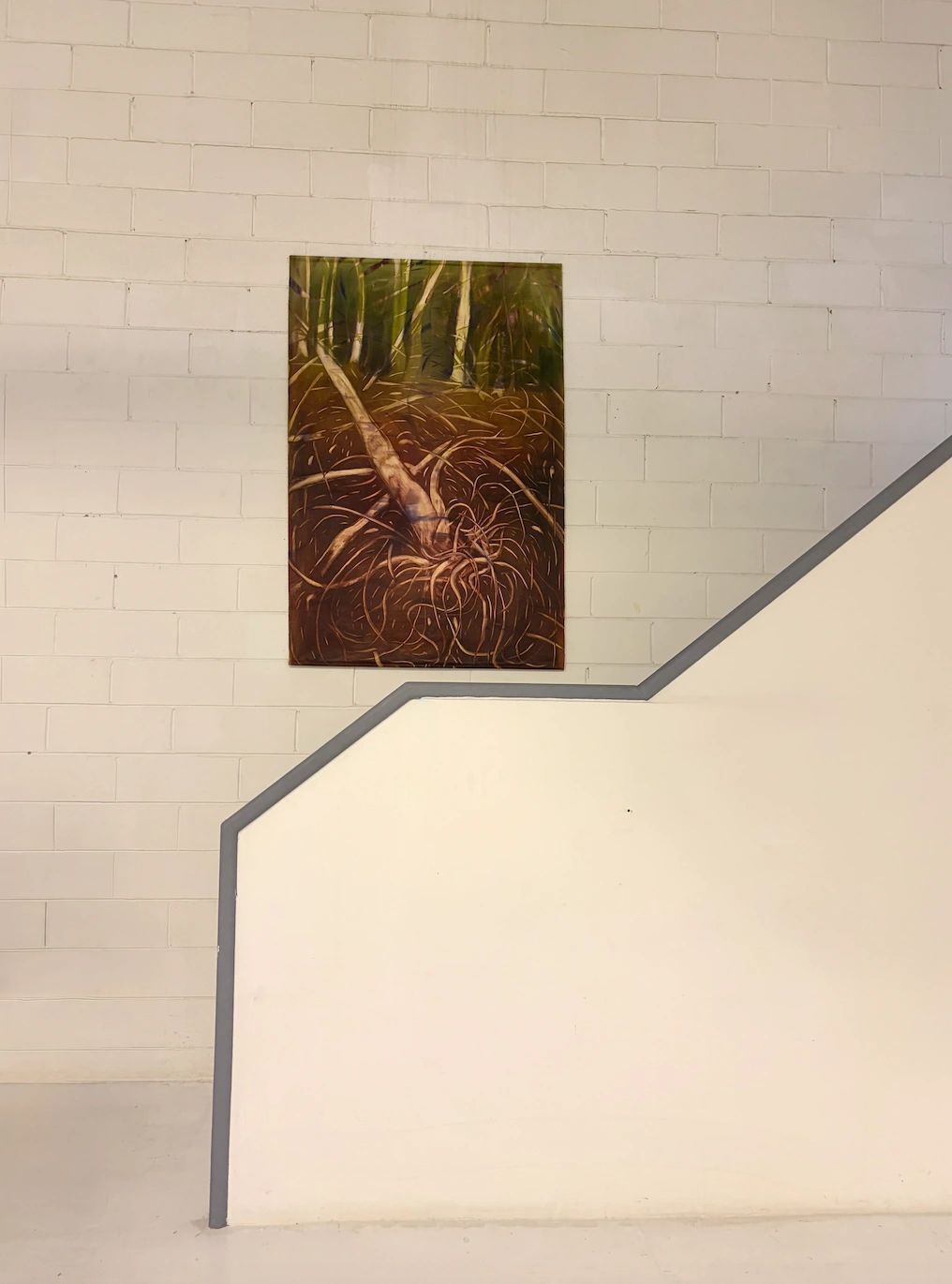
Installation view.

Gallery view.